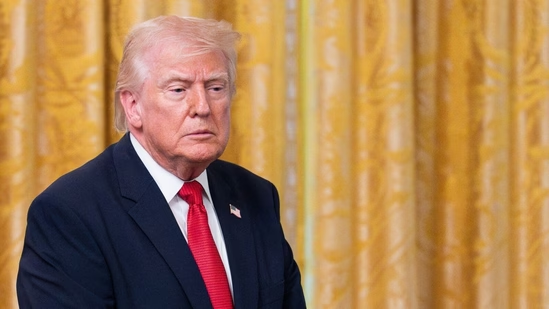

President Donald Trump asserted Wednesday that Iran’s leadership is in a state of internal collapse, claiming that the “fear of assassination” has left the regime unable to find a willing successor for the role of Supreme Leader.
Speaking at a National Republican Congressional Committee (NRCC) fundraiser, Trump told donors that the geopolitical pressure on Tehran has reached a breaking point. He suggested that while the Iranian government publicly denies engagement, officials are privately “desperate” to secure a deal with Washington.
A “Job No One Wants”
The President’s remarks centered on the current power vacuum in Tehran following the assassination of Ayatollah Ali Khamenei. The successor, Ayatollah Mojtaba Khamenei, has not been seen in public since reportedly being injured in a series of joint IS-Israeli strikes.
“There has never been a head of a country that wanted that job less,” Trump said, referring to the Supreme Leadership. “The sentiment is that whoever takes it will be killed—either by their own people or by us.”
Trump claimed he has settled eight international conflicts and is currently “finishing off” a major war in the Middle East. He characterized the Iranian regime’s nuclear ambitions as a “cancer” that his administration is systematically extracting.
Conflicting Reports on Negotiations
The President’s narrative of a regime ready to capitulate stands in stark contrast to official statements from Tehran. Iranian Foreign Minister Abbas Araghchi recently reiterated that Iran “does not intend to negotiate,” dismissing U.S. claims of “productive talks” as propaganda.
Trump, however, insisted that the denials are a survival tactic. “They are negotiating, by the way,” Trump told the crowd. “They want to make a deal so badly, but they are afraid to say it out loud because they think their own side will kill them.”
The Shadow of Mojtaba Khamenei
The stability of the Iranian state remains a point of intense investigative interest. Since taking over the position, Mojtaba Khamenei has governed through written proxies. His most recent communications—an Eid al-Fitr and Nowruz message—were delivered via a written statement read by state television anchors rather than a video or live appearance.
This absence has fueled international speculation regarding the extent of his injuries and the actual level of control he exerts over the Revolutionary Guard.
Trump’s rhetoric suggests the U.S. is banking on this internal instability to force a nuclear breakthrough. “We have cut [the cancer] out,” Trump concluded. “Now we are going to finish it off.”