
Seven House Democrats broke with much of their party and voted to support funding for U.S. Immigration and Customs Enforcement (ICE), helping push a Department of Homeland Security (DHS) spending measure forward even as progressives rallied against it.
The bill passed 220–207, with Representative Thomas Massie of Kentucky casting the lone Republican “no” vote. The measure would keep DHS funded — including ICE and FEMA — through September 30.
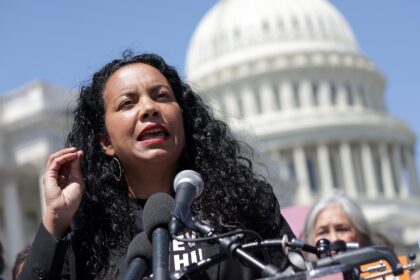
“Right now we are about to take a vote and that vote is on DHS and whether or not we will give more funding to ICE. Right now I am willing to shut it down. I am going to do what it takes instead of just kind of being a go-along to get-along lawmaker,” Representative Jasmine Crockett, a Texas Democrat, told Newsweek ahead of the vote.
The Democrats Who Voted Yes
The seven Democratic representatives who voted to approve ICE funding were:
- Tom Suozzi (New York)
- Henry Cuellar (Texas)
- Don Davis (North Carolina)
- Laura Gillen (New York)
- Jared Golden (Maine)
- Vicente Gonzalez (Texas)
- Marie Glusenkamp Perez (Washington)
House Democrats Split as Leadership Opposes the Bill
Ahead of the vote, House Democratic leaders announced their opposition to the DHS package — a stance shaped by pressure from rank-and-file members to take a harder line against President Donald Trump’s immigration crackdown.
“Taxpayer dollars are being misused to brutalize U.S. citizens, including the tragic killing of Renee Nicole Good. This extremism must end,” said a statement from Democratic leader Hakeem Jeffries, Democratic Whip Katherine Clark and Democratic Caucus Chair Pete Aguilar.
With Republicans holding a narrow 218–213 majority, Democrats argued they had limited leverage to block DHS funding outright — even as frustration over immigration enforcement actions intensified.
Typically, when lawmakers hit a funding stalemate, Congress turns to short-term stopgaps known as continuing resolutions to keep agencies running at current levels. But in this case, that path would hand broader discretion over DHS spending to Trump, said Rosa DeLauro of Connecticut, the top Democrat on the House Appropriations Committee.
Warnings of Disaster Relief Fallout — and What ICE Gets
Some Democrats who supported the bill — and others urging caution — argued that letting DHS funding lapse could disrupt disaster response and strain agencies like the Transportation Security Administration, while ICE and Customs and Border Protection could keep operating with relatively little interruption.
They pointed to money provided in last year’s sweeping Republican tax and immigration law, which set aside tens of billions for border enforcement. ICE, which typically receives about $10 billion a year through annual appropriations, was granted $30 billion for operations and $45 billion for detention facilities under that legislation.
The DHS bill passed by the House keeps ICE’s yearly congressional funding roughly flat compared with last year. It also limits the authority of DHS Secretary Kristi Noem to shift funds unilaterally and requires monthly reports detailing how the department plans to spend money tied to Trump’s law. The bill includes $20 million to purchase and operate body cameras for ICE and CBP officers during immigration enforcement activities.
“It’s not everything we wanted,” said Cuellar, a senior Democrat on the Appropriations Committee. “We wanted more oversight. But Democrats don’t control the House, the Senate or the White House. What we were able to do was add some oversight over Homeland.”
Democrats Unload on ICE During Debate
During floor debate, Democratic lawmakers blasted ICE, accusing the agency of abusive enforcement tactics.
Representative Betty McCollum of Minnesota said residents in her state were being racially profiled and detained.
“Masked federal agents are seizing parents, yes, in front of terrified children,” McCollum said. “And many of these people we’re finding had no record and were here legally.”
“I will not fund an agency that acts like an American Gestapo,” said Representative Jerrold Nadler of New York.
“This is about the political retribution of a vengeful president,” said Clark of Massachusetts. “I will not rubber-stamp the federal government’s use of political violence against its own people and I ask every member to join me in voting no.”
What Happens Next
The House approved the final set of spending bills for the year in an effort to avoid another government funding lapse, with lawmakers still wary after the fall’s record 43-day shutdown.
The four measures — totaling about $1.2 trillion — now head to the Senate. Lawmakers there must act by the January 30 deadline to avoid a partial federal shutdown. Three other bills passed with broad bipartisan support, funding the Defense Department and other agencies, including Education, Transportation, and Health and Human Services.
In a late change to the DHS package, House leaders added a provision that would have repealed senators’ ability to sue the government over the collection of their cellphone data during former special counsel Jack Smith’s January 6 investigation. The House later unanimously agreed to block that provision.