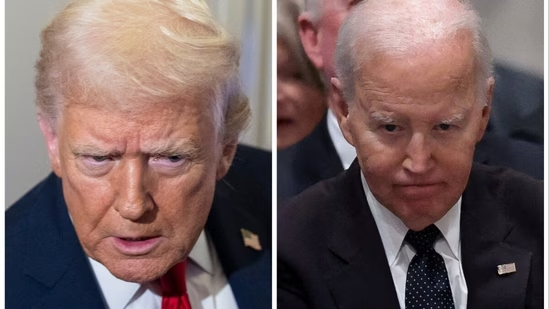

President Trump continues to fault former President Biden for everything from stubborn living costs to the recent shooting of two National Guard members in Washington, D.C.
But with Trump now back in the Oval Office for nearly a year, there are growing signs that this line of attack is losing some of its punch.
At the White House on Tuesday, Trump dismissed the focus on “affordability” as “a Democrat scam” and spoke at length about his efforts to push prices down.
Yet the latest inflation reading from the Bureau of Labor Statistics — 3 percent annually in September — is identical to the figure recorded in January, when Biden departed the White House.
On the National Guard shooting, Trump has tried to tie responsibility to his predecessor. The suspect, Afghanistan-born Rahmanullah Lakanwal, did arrive in the United States while Biden was in office.
However, the picture is more complicated for Trump: Lakanwal was granted asylum in April, three months into Trump’s own presidency. Many details surrounding the shooting that killed Guard member Sarah Beckstrom and wounded Andrew Wolfe also remain murky.
As the country moves toward a midterm election year, Democrats argue that Trump’s attacks on Biden are starting to feel stale.
“I believe there are diminishing returns to the attacks against Biden,” said New York-based Democratic strategist Basil Smikle Jr.
“There is a portion of Trump’s base that will always support such attacks and statements. But when we look at the polling, it is clear that independent voters are starting to turn away from Trump, which suggests to me that those attacks are starting to wear very thin.”
Trump’s approval ratings, never especially strong, slipped noticeably last month. In the average compiled by The Hill’s partner, Decision Desk HQ, he is currently 11 points underwater: 53 percent of respondents disapprove of his job performance, while 42 percent approve.
Even more troubling for Trump are perceptions of his handling of the economy, particularly inflation.
A Yahoo/YouGov survey released late last month found that just 31 percent of Americans approve of his approach to the cost of living, while 63 percent disapprove.
Partisanship strongly shapes whom voters blame for economic pain, but Trump faces serious problems with people in the political middle.
The same Yahoo/YouGov poll showed 38 percent of Americans holding Trump responsible for inflation, compared with 31 percent who point the finger at Biden.
A Fox News poll, also released last month, painted an even darker picture for the president. Voters said Trump bears more responsibility than Biden for the state of the economy by nearly a 2-to-1 margin, 62 percent to 32 percent.
In another question, only 15 percent of voters said they feel helped by Trump’s economic policies, while 46 percent said they have been hurt and 39 percent saw no real effect either way.
Inflation itself remains a politically thorny topic because of its complexity.
Price growth hit its highest level in decades under Biden, peaking at 9.1 percent on an annual basis in June 2022.
Critics of the then-president argued that massive government spending to soften the blow of the COVID-19 pandemic sent prices soaring. Biden allies countered that snarled supply chains were largely to blame.
Whatever the cause, inflation did steadily fall from that peak through the end of 2023. But since then it has hovered stubbornly around 3 percent — above the Federal Reserve’s 2 percent target. Voter frustration with elevated prices was a major obstacle for Democrats as they tried, unsuccessfully, to keep the White House with then–Vice President Kamala Harris last year.
Trump’s own economic record is tightly linked to his enthusiasm for tariffs. Inflation has not climbed as sharply as some experts feared, but it also has not declined over the past year. That leaves him politically exposed, especially given that lowering costs was one of his signature campaign promises.
“Starting the day I take the oath of office, I will rapidly drive prices down and we will make American affordable again,” Trump vowed at an August 2024 campaign rally in Pennsylvania.
His messaging has evolved, but his flair for exaggeration has not. On Tuesday at the White House, he claimed of the Biden years, “They had the worst inflation in the history of our country.”
That is incorrect. Inflation was higher at the start of the 1980s — and at several earlier points in U.S. history — than at any time during Biden’s presidency.
Still, Republicans broadly back Trump’s attempt to frame current conditions in light of the previous administration.
GOP strategist Brad Blakeman said, “The whole [2024] election turned on the record of the prior administration, so you know it doesn’t stop after Election Day.
“Obviously, the American people were not happy with the prior administration. The president, in the process of trying to pick up the pieces, is justifiably explaining where we’ve been, where we’re headed and why he’s doing what he’s doing.”
Blakeman added that this argument extends beyond headline inflation and touches on policy areas such as expanded subsidies for people who get health insurance through the Affordable Care Act (ACA), enacted in 2010 under former President Obama.
He argued that voters were given unrealistic assurances that the ACA would be self-sustaining and that this has not borne out in practice.
Even so, Blakeman conceded that Republicans running in next year’s midterm contests need to offer more than criticism — even as he avoided directly faulting Trump.
“The president is term-limited — and a different character completely,” he said.
This column is part of The Memo, reported by Niall Stanage.