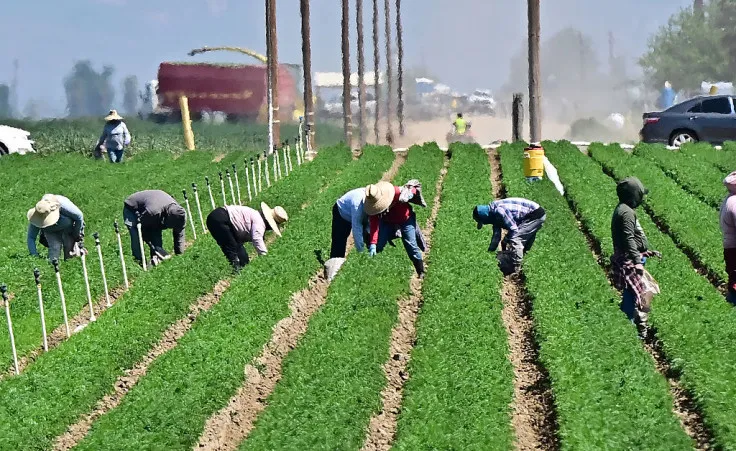

The Trump administration is making it easier for farmers to hire foreign labor through the H-2A visa program, even as immigration enforcement appears to be pulling back from farm workplace raids, according to a Stateline report. The twin moves come amid mounting political heat over high grocery prices and the White House’s recent decision to lift tariffs on several imported food products.
Last month, the administration rolled out changes to the H-2A agricultural visa system aimed at speeding approvals. Under the update, the Department of Homeland Security can process visas more quickly to help address persistent labor shortages in the fields.
In a statement to Stateline, the U.S. Department of Agriculture said the administration is “prioritizing fixing programs farmers and ranchers rely on.” That push sits alongside a broader message from the White House favoring domestic labor: Agriculture Secretary Brooke Rollins said in July that the goal of a “100% American workforce” remained in place.
The H-2A program has issued about 420,000 visas a year since 2023, filling roughly half of all agricultural jobs. With the expansion, the government expects to approve an additional 119,000 visas annually. The rule also reduces mandatory minimum wages for H-2A workers in many states and lets employers charge for housing that had previously been provided at no cost.
In North Carolina, for example, the hourly wage for unskilled H-2A workers dropped sharply — from $16.16 to $11.09.
Farm industry groups have applauded the shift, arguing it offers urgent relief. Lee Wicker of the North Carolina Growers Association said the new wage structure reflects harsh realities in the sector. “If you think farmers are making more money in these conditions, you’re wrong. They’re going broke,” he said, adding that he expects many workers will still come back despite the lower pay. Jeffrey Dorfman, an economics professor at North Carolina State University, said the changes could save farmers “tens of millions of dollars statewide.”
Labor organizations, however, say the policy strips protections from a workforce already under pressure. Antonio De Loera-Brust of the United Farm Workers criticized the move as a give-back to business interests after earlier enforcement actions rattled laborers. “First came the raids, which hurt workers, and now in order to appease business interests, they make all these concessions on wages and the guest workers program,” he said.
At the same time, growers and researchers say Immigration and Customs Enforcement has recently eased off farm raids. After several agricultural workplace operations earlier this year, enforcement has shifted toward other industries, experts say. “We really haven’t seen agriculture targeted with worksite enforcement efforts,” said Julia Gelatt of the Migration Policy Institute. She noted that previous administrations have also quietly deprioritized farm raids without formal announcements.
Wicker said North Carolina farms haven’t been hit, even as ICE activity rises in cities. De Loera-Brust warned that while field raids have slowed, they could restart abruptly, keeping workers on edge and unsure about their safety and stability.
The labor policy change is unfolding alongside new trade decisions affecting food prices. FreshPlaza reported this week that importers had mixed reactions to the administration lifting tariffs on items such as bananas, coffee, and beef. Some said retailers might not pass savings along to consumers, while others viewed the move as a stabilizer for supply chains strained by tight global production.
Daniella Velazquez De Leon of Organics Unlimited said the tariff rollback brings “some much-needed stability and predictability,” but cautioned that pricing will still be shaped by limited supply, weather swings, and crop disease risks.