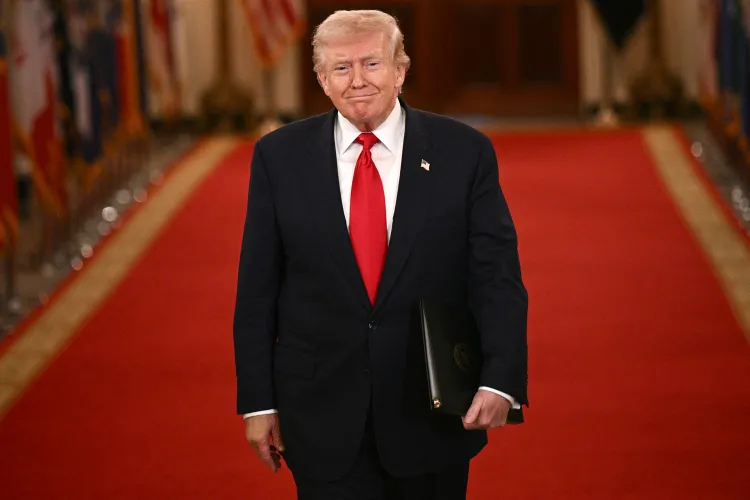

President Donald Trump on Monday announced a five-day postponement of threatened military strikes against Iranian power infrastructure, claiming the U.S. is engaged in “productive” negotiations to end the month-long conflict. However, Iranian officials immediately countered the claim, dismissing reports of high-level talks as a strategic fabrication.
In an early morning dispatch on Truth Social, the 79-year-old president cited “in depth, detailed and constructive” conversations regarding a total resolution of hostilities. The move temporarily shelves a Saturday ultimatum in which Trump vowed to “obliterate” Iran’s power grid—starting with its largest plants—if Tehran failed to “fully open” the Strait of Hormuz within 48 hours.
The Strait serves as the world’s most critical oil chokepoint, with approximately one-fifth of global supply passing through the waterway. Trump’s announcement sparked an immediate, though brief, decline in global oil prices.
The diplomatic breakthrough claimed by the White House was swiftly rejected by Iranian state-operated media and the semi-official Tasnim News Agency.
“No negotiations have taken place and none are underway,” Tasnim reported, characterizing the President’s statements as “psychological warfare” intended to manipulate energy markets and buy time for military positioning.
The Iranian Foreign Ministry added that while regional mediators have attempted to de-escalate the war—which began February 28—Tehran remains focused on achieving a “required level of deterrence” before halting defensive operations.
Speaking to reporters outside Air Force One, Trump suggested that the internal chaos within the Iranian government might explain the conflicting reports.
:max_bytes(150000):strip_icc():focal(663x492:665x494):format(webp)/President-Donald-Trump-White-House-oval-office-032326-977a6bf7fba34e78a5e7eed15035143b.jpg)
“Communication has been blown to pieces,” Trump stated, noting that some Iranian officials might be unaware of the back-channel discussions. He identified U.S. Special Envoy Steve Witkoff and Jared Kushner as key figures involved in recent talks.
The President declined to name the specific Iranian representative involved, though he clarified it was not Mojtaba Khamenei, the son of the late Supreme Leader Ayatollah Ali Khamenei. The elder Khamenei was killed in preliminary U.S. strikes, and U.S. Defense Secretary Pete Hegseth has recently questioned whether Mojtaba is still alive or capable of leading.
:max_bytes(150000):strip_icc():focal(675x244:677x246):format(webp)/donald-trump-oval-office-white-house-washington-dc-031626-7958f21c722a4c2c9766ba227a201056.jpg)
Despite the optimism of his public statements, Trump maintained a hardline stance should the alleged talks collapse. “We have a very serious chance of making a deal,” Trump said. “But if they don’t carry through… we’ll just keep bombing.”
The administration continues to pressure allies to assist in securing the Strait of Hormuz, as the war continues to threaten global energy stability and domestic gas prices.