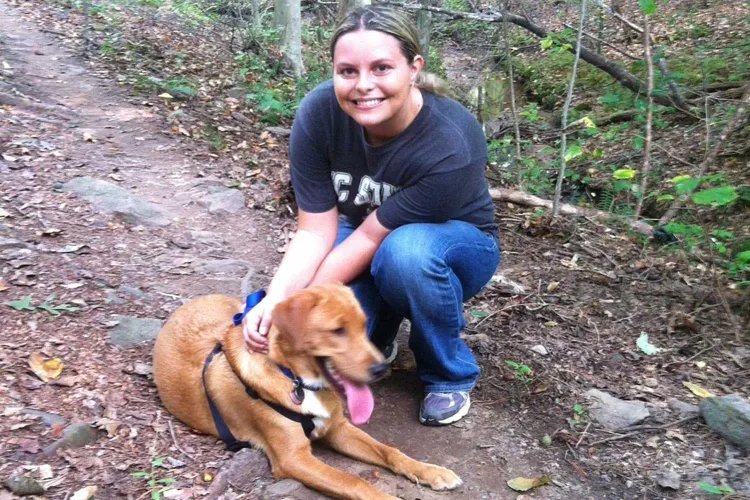

CARY, N.C. — Chase Johnson, a 36-year-old attorney, is credits her Labrador retriever mix, Ceto, with saving her life after the dog’s persistent “nose-poking” led to an early diagnosis of an aggressive form of breast cancer. The incident marks the second time the rescue dog has successfully alerted the household to a life-threatening malignancy, according to reports from SWNS.
In late 2021, Johnson noticed a marked shift in Ceto’s behavior at her home in Cary. The dog began whimpering and exhibiting signs of anxiety, specifically focusing on Johnson’s left side. The behavior culminated in a direct poke to her left breast, which prompted Johnson to perform a self-examination.
Upon feeling a lump, she sought immediate medical consultation. Diagnostic testing confirmed triple-negative breast cancer (TNBC), a subtype known for its rapid growth and limited treatment targets compared to other breast cancers.
:max_bytes(150000):strip_icc():focal(477x432:479x434):format(webp)/Chase-Johnson-022626-11c2742939384f2893522ddc883448fd.jpg)
A Pattern of Medical Detection
While anecdotal accounts of canine cancer detection are frequent, the Johnson household provides a rare double-case study. Prior to Johnson’s diagnosis, Ceto had exhibited similar distress and alerting behaviors toward her husband, Ben Byrn.
That interaction led Byrn to seek medical attention, resulting in a diagnosis of colon cancer.
“If I didn’t have Ceto, and if I didn’t have that past experience with my husband, I might not be here,” Johnson told SWNS. “He had alerted [Ben] to the fact that he had cancer previously.”
Treatment and Recovery
Following the 2021 discovery, Johnson underwent a rigorous multi-modal treatment plan, including:
- Chemotherapy to shrink the aggressive tumor.
- Radiotherapy to target remaining localized cells.
- Surgical Intervention, specifically a lumpectomy and lymph node removal.
As of February 2026, medical professionals have declared Johnson cancer-free. Her story highlights a growing interest in the “canine scent” phenomenon, where dogs—possessing up to 300 million olfactory receptors—detect volatile organic compounds (VOCs) produced by malignant tumors.
:max_bytes(150000):strip_icc():focal(469x244:471x246):format(webp)/Ceto-022626-860289fd6e504ebfa6165bb7051b0ebd.jpg)
The Science of Canine Alerts
While the American Cancer Society emphasizes that dogs are not a substitute for clinical screenings like mammograms or colonoscopies, Johnson’s case aligns with ongoing research into “bio-detection.” Studies have shown that trained dogs can identify the “smell” of cancer in breath, sweat, and urine samples with high accuracy.
In Johnson’s case, the dog’s behavioral persistence acted as a biological red flag that bypassed the typical waiting period for a routine check-up.
Looking Ahead
Johnson now advocates for increased awareness of both triple-negative breast cancer and the importance of listening to one’s body—and, in her case, her pets. Medical researchers continue to study the specific compounds dogs sense in hopes of developing “electronic noses” that can mimic this early-detection capability in a clinical setting.
For the Johnson-Byrn family, the focus remains on the bond with Ceto, who transitioned from a family pet to a literal lifesaver twice over.