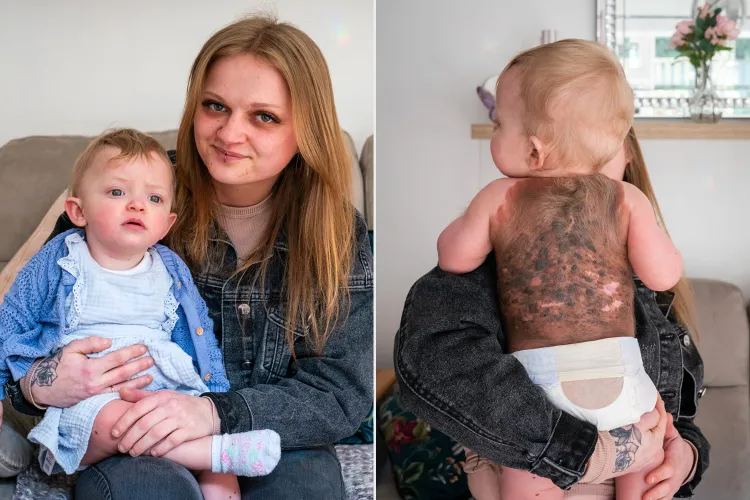

A 10-month-old girl in Plymouth, England, is facing a life-threatening cancer diagnosis after a rare birthmark developed malignant lesions, her family confirmed this month. The case has drawn international attention due to the extreme rarity of the condition manifesting as an aggressive malignancy in infancy.
Macey-Mai was born in May 2025 with Giant Congenital Melanocytic Nevus (GCMN), a rare skin condition characterized by abnormally dark, tumor-like pigmentations. According to the National Institutes of Health (NIH), GCMN is typically noncancerous but carries a significantly elevated risk of developing melanoma, an aggressive and often fatal form of skin cancer.
For Macey-Mai, the condition is extensive. The primary nevus covers her entire back, while over 100 smaller “satellite” marks are scattered across her stomach, scalp, and limbs.
:max_bytes(150000):strip_icc():focal(717x349:719x351):format(webp)/macey-mai-baby-cancerous-birthmark-032526-1-78844b8d01c34b778f8904fb2b2b0de0.jpg)
The medical situation escalated when seven painful, rapidly growing lesions appeared on the infant’s back. In August 2025, surgeons removed the growths for genetic testing and biopsies. While the family monitored the infant daily for changes in the size or texture of the remaining marks, the definitive results arrived in March 2026.
:max_bytes(150000):strip_icc():focal(749x0:751x2):format(webp)/macey-mai-baby-cancerous-birthmark-032526-5-66cbf58d4be54316935cfa06f8937321.jpg)
Tests confirmed that at least one of the removed lesions was malignant.
“I knew that with this condition you would probably face malignancy at some point, but they said that’s when you are an adult,” said Katelyn Clarke, Macey-Mai’s mother. “They never say that you can be born with it.”
:max_bytes(150000):strip_icc():focal(749x0:751x2):format(webp)/macey-mai-baby-cancerous-birthmark-032526-6-afc3dad7e19146cf80d11174c8e8cd18.jpg)
The case highlights a critical medical anomaly, as GCMN-related melanoma usually presents later in life. Medical teams are currently monitoring the infant for signs of metastasis, as the remaining lesions continue to grow.
Clarke has launched a GoFundMe campaign to document the journey and seek support for the intensive treatments ahead. Macey-Mai is scheduled for further surgeries to address the remaining high-risk areas. As the family approaches the infant’s first birthday in May, the focus remains on aggressive clinical intervention and pain management.